
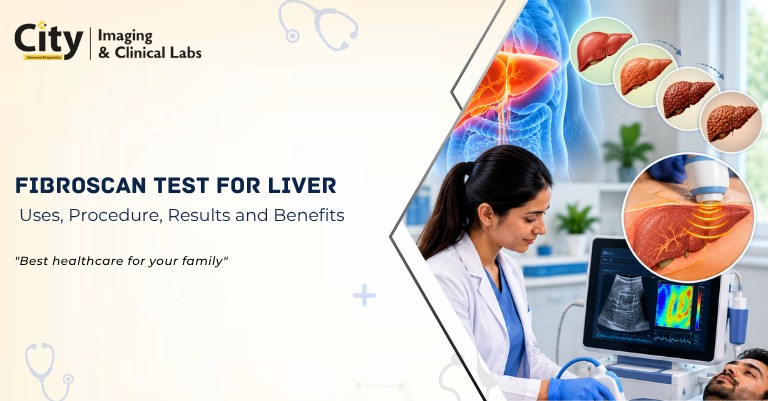
FibroScan Test for Liver-Related Diseases: Uses, Procedure, Results and Benefits

- Key Takeaways
- What Is a FibroScan Test?
- Why Is FibroScan Done for Liver Diseases?
- What Liver Problems Can FibroScan Help Detect?
- FibroScan and Liver Fibrosis
- What Is the CAP Score in FibroScan?
- FibroScan Test Procedure: What Happens During the Test?
- Is FibroScan Painful?
- How to Prepare for a FibroScan Test
- How Are FibroScan Results Reported?
- FibroScan vs Liver Biopsy
- Who May Need a FibroScan Test?
- How Often Should FibroScan Be Done?
- Benefits of FibroScan for Liver Disease Assessment
- When Should You Consider a FibroScan?
- FibroScan Test in Delhi
- Frequently Asked Questions About FibroScan
- Key Takeaway
- Related Articles
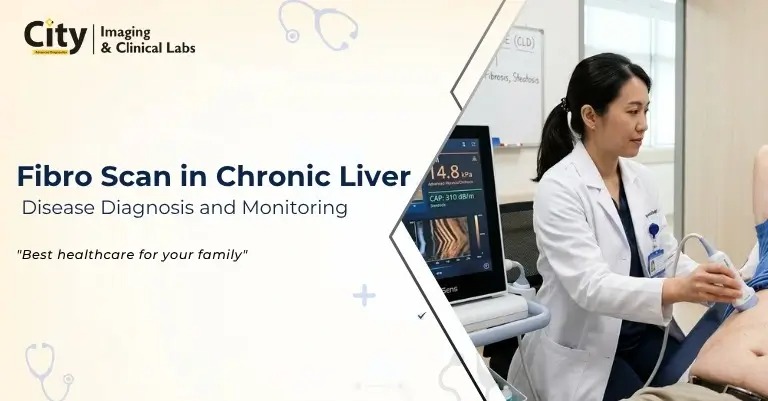
FibroScan is a non-invasive liver test used to assess liver stiffness and estimate the amount of fibrosis (scarring) in the liver. It can also measure controlled attenuation parameter (CAP), which helps estimate liver fat. The test is commonly used in people with fatty liver disease, hepatitis B or C, alcohol-related liver disease and other conditions that may cause liver damage.
Liver disease can develop gradually, and many people may not experience noticeable symptoms during the early stages. A FibroScan test provides doctors with useful information about liver stiffness and fat without requiring a liver biopsy in many cases.
If you are looking for a FibroScan test in Delhi, City Imaging provides diagnostic imaging and testing services at convenient locations across Delhi NCR.
Key Takeaways
- FibroScan measures liver stiffness (fibrosis) and, with CAP, liver fat.
- It is painless, needs no needles and usually takes only a few minutes.
- Many centres ask you to fast for several hours before the test.
- Results are in kPa (stiffness) and dB/m (CAP) and must be read by a doctor with other tests.
- FibroScan may not replace a liver biopsy in every case.
What Is a FibroScan Test?
A FibroScan is a specialized, non-invasive examination that uses transient elastography to assess the condition of the liver.
Unlike a conventional ultrasound, which mainly produces images of organs, FibroScan measures how stiff the liver tissue is. Increased liver stiffness can be associated with liver fibrosis or cirrhosis.
FibroScan can also provide a CAP score, which helps estimate the amount of fat stored in the liver.
The test is generally:
- Non-invasive
- Painless
- Quick to perform
- Performed without needles
- Usually completed within a few minutes
- Useful for monitoring liver disease over time
Why Is FibroScan Done for Liver Diseases?
Liver injury can cause inflammation and progressive scarring. Over time, significant fibrosis may develop and potentially progress to cirrhosis.
A FibroScan can help doctors assess the extent of liver damage and monitor changes over time.
It may be recommended for people with conditions such as:
- Fatty liver disease
- Metabolic dysfunction-associated steatotic liver disease (MASLD)
- Metabolic dysfunction-associated steatohepatitis (MASH)
- Chronic hepatitis B
- Chronic hepatitis C
- Alcohol-related liver disease
- Suspected liver fibrosis
- Cirrhosis
- Other chronic liver conditions
The test may also be considered when a doctor wants to assess liver fibrosis without immediately performing an invasive procedure.
What Liver Problems Can FibroScan Help Detect?
FibroScan does not diagnose every liver disease by itself. Instead, it provides measurements that can help doctors assess liver stiffness and liver fat alongside symptoms, blood tests, medical history and other investigations.
1. Fatty Liver Disease
Fat accumulation in the liver can occur because of metabolic factors, obesity, diabetes, alcohol consumption and other causes.
FibroScan's CAP measurement can help estimate liver fat, while liver stiffness measurement can provide information about possible fibrosis. See our guide on FibroScan for fatty liver disease.
2. Hepatitis B
Chronic hepatitis B can cause ongoing inflammation and liver injury. FibroScan may be used to assess liver stiffness and monitor fibrosis in people with chronic hepatitis B. A hepatitis B profile or HBsAg test is often done along with it.
3. Hepatitis C
Long-term hepatitis C infection can cause progressive liver damage. FibroScan can help evaluate liver stiffness and monitor fibrosis, particularly during long-term disease management. The Anti-HCV test is commonly used to screen for it. Read more about hepatitis types, symptoms and tests.
4. Alcohol-Related Liver Disease
Long-term excessive alcohol consumption can contribute to fatty liver, inflammation, fibrosis and cirrhosis.
FibroScan may help doctors evaluate liver stiffness and monitor the progression or improvement of liver disease.
5. Liver Fibrosis and Cirrhosis
Repeated liver injury can result in fibrosis, where healthy liver tissue is gradually replaced by scar tissue.
Advanced fibrosis can progress to cirrhosis. FibroScan provides a liver stiffness measurement that can help doctors assess the likelihood and severity of significant fibrosis. Learn more about the role of FibroScan in liver fibrosis and cirrhosis.
FibroScan and Liver Fibrosis
One of the main reasons doctors recommend FibroScan is to assess liver fibrosis.
Fibrosis develops when the liver repeatedly experiences injury or inflammation. In its early stages, fibrosis may have few or no symptoms.
FibroScan measures liver stiffness in kilopascals (kPa). In general, higher liver stiffness can be associated with more advanced fibrosis.
However, FibroScan results should not be interpreted using a single universal cutoff for every patient. The appropriate range can vary depending on the underlying liver disease, inflammation, congestion, fasting status and other clinical factors.
Therefore, your doctor should interpret the result together with your medical history and other test results.
What Is the CAP Score in FibroScan?
The Controlled Attenuation Parameter (CAP) is a measurement obtained during FibroScan that helps estimate the amount of fat in the liver.
CAP is expressed in decibels per meter (dB/m).
A higher CAP value generally indicates a greater amount of liver fat. However, interpretation depends on the clinical situation and the measurement method used.
FibroScan therefore provides two important types of information:
| Measurement | What It Indicates |
|---|---|
| Liver Stiffness Measurement (LSM) | Helps assess liver stiffness and possible fibrosis |
| CAP Score | Helps estimate liver fat |
FibroScan Test Procedure: What Happens During the Test?
A FibroScan examination is relatively simple.
Step 1: You lie down
You will usually lie on your back with your right arm raised or positioned to allow access to the right side of the abdomen.
Step 2: The operator locates the liver
A FibroScan probe is placed against the skin over the liver area.
Step 3: Measurements are taken
The device sends controlled vibrations through the liver and measures how quickly the resulting waves travel through the liver tissue.
The device then calculates liver stiffness.
Step 4: CAP measurement may be recorded
The same examination can provide a CAP measurement to estimate liver fat.
Step 5: Results are reviewed
The measurements are assessed for reliability and interpreted along with your medical history and other investigations.
The procedure usually takes only a few minutes.
Is FibroScan Painful?
No. FibroScan is generally painless and does not require needles or an incision.
You may feel mild pressure or vibration when the probe is placed against your abdomen, but most people tolerate the examination comfortably.
Because it is non-invasive, FibroScan can be repeated when medically appropriate to monitor liver health.
How to Prepare for a FibroScan Test
Preparation requirements can vary according to the diagnostic centre and the doctor's instructions.
In many cases, patients are advised to avoid eating for several hours before the examination, because recent food intake may affect liver stiffness measurements.
Before your appointment:
- Follow the fasting instructions provided by the diagnostic centre.
- Wear comfortable clothing that allows access to the upper abdomen.
- Tell the healthcare professional about your medications and medical conditions.
- Follow any additional instructions provided by your doctor or diagnostic centre.
If you are unsure whether you need to fast, confirm the requirement before your test.
How Are FibroScan Results Reported?
FibroScan commonly provides a liver stiffness measurement in kPa and a CAP measurement in dB/m.
The liver stiffness result can help doctors estimate the likelihood of liver fibrosis. CAP can provide an estimate of liver fat.
However, FibroScan numbers should not be interpreted in isolation.
Factors such as active liver inflammation, congestion, cholestasis, recent food intake and technical factors can influence liver stiffness measurements.
Your doctor may compare FibroScan findings with:
- Liver function tests (see our guide on LFT types, preparation and results)
- ALT and AST (SGOT)
- Bilirubin
- Platelet count (part of a CBC)
- Viral hepatitis tests
- Ultrasound findings
- Medical history
- Symptoms
- Other fibrosis scores or investigations
FibroScan vs Liver Biopsy
FibroScan and liver biopsy are different tests.
| Feature | FibroScan | Liver Biopsy |
|---|---|---|
| Invasive | No | Yes |
| Needle required | No | Yes |
| Tissue sample | No | Yes |
| Measures liver stiffness | Yes | Assessed indirectly through tissue examination |
| Estimates liver fat | CAP measurement | Can assess fat directly in tissue |
| Recovery time | Usually none | May require recovery |
| Repeat testing | Generally easier | Less convenient because it is invasive |
A liver biopsy may still be recommended in selected situations when detailed microscopic examination of liver tissue is necessary.
Who May Need a FibroScan Test?
A doctor may recommend FibroScan if you have:
- Persistent abnormal liver enzymes
- Fatty liver
- Chronic hepatitis B or C
- A history of significant alcohol consumption
- Suspected liver fibrosis
- Risk factors for chronic liver disease
- Previously diagnosed liver disease requiring monitoring
Not everyone with an abnormal liver test needs FibroScan. The decision depends on the individual's medical history and clinical assessment. People with obesity may need a special probe; see why FibroScan with the XL probe is recommended in obese patients.
How Often Should FibroScan Be Done?
There is no single testing interval that applies to everyone.
The frequency depends on the underlying liver condition, fibrosis stage, treatment, risk factors and your doctor's recommendations.
For example, a person being monitored for chronic liver disease may need periodic assessment, while someone with a low-risk finding may not require frequent testing.
Your doctor can determine an appropriate follow-up schedule based on your individual condition.
Benefits of FibroScan for Liver Disease Assessment
FibroScan offers several practical advantages:
- Non-invasive: No tissue sample is required.
- Painless: The examination is generally comfortable.
- Quick: The measurement can usually be completed within minutes.
- No recovery period: Most people can resume normal activities afterward.
- Repeatable: It can be used for follow-up monitoring when medically appropriate.
- Assesses liver stiffness: Provides quantitative information that can support fibrosis assessment.
- Estimates liver fat: CAP can provide information about hepatic steatosis.
When Should You Consider a FibroScan?
You may want to discuss FibroScan with your doctor if you have been diagnosed with fatty liver, chronic hepatitis or another condition that can cause progressive liver damage.
It may also be considered when blood tests or imaging suggest possible liver disease and your doctor wants additional information about liver stiffness.
FibroScan is an assessment tool, not a standalone diagnosis. A healthcare professional should interpret the findings in the context of your symptoms, medical history and other test results. Tests such as HbA1c are often checked together in people with fatty liver; read about the HbA1c test, range and results.
FibroScan Test in Delhi
If you are searching for a FibroScan test in Delhi, City Imaging offers diagnostic services with convenient appointment options. See also our ultrasound services and clinical pathology services.
Before booking, patients should confirm the test availability, preparation requirements and current FibroScan test price in Delhi, as charges can vary depending on the centre and services provided.
For patients with an existing liver condition, it is advisable to carry previous reports, prescriptions and relevant blood-test results so that the healthcare team has appropriate clinical information.
Frequently Asked Questions About FibroScan
1. What is a FibroScan test used for?
FibroScan is primarily used to assess liver stiffness, which can help evaluate liver fibrosis. Its CAP measurement can also estimate liver fat.
2. Is FibroScan the same as an ultrasound?
No. Both are non-invasive examinations, but they provide different information. FibroScan measures liver stiffness and can estimate liver fat, whereas conventional ultrasound produces images of the liver and surrounding organs.
3. Is FibroScan painful?
No. FibroScan is generally painless and does not require needles or an incision.
4. Does FibroScan detect fatty liver?
FibroScan can estimate liver fat using the CAP measurement. Your doctor may combine this information with ultrasound, blood tests and other clinical findings.
5. Can FibroScan detect liver cirrhosis?
FibroScan can provide information about liver stiffness that may support the assessment of advanced fibrosis or cirrhosis. However, the result should be interpreted with other clinical and laboratory findings.
6. Do I need to fast before FibroScan?
Many centres recommend fasting for several hours before FibroScan. Follow the specific preparation instructions given by your diagnostic centre or doctor.
7. How long does a FibroScan take?
The actual examination is usually completed within a few minutes, although the total appointment time may vary.
8. What does a high FibroScan score mean?
A higher liver stiffness measurement may indicate a greater likelihood of significant fibrosis, but the result does not automatically establish a diagnosis. Liver stiffness can also be affected by factors such as inflammation and congestion.
9. Can FibroScan replace a liver biopsy?
Not always. FibroScan can provide valuable non-invasive information, but a liver biopsy may still be required in selected patients when microscopic examination of liver tissue is clinically necessary.
10. Where can I get a FibroScan test in Delhi?
FibroScan availability varies by diagnostic centre. Patients can check with City Imaging for current availability, appointment options and pricing.
Key Takeaway
FibroScan is a quick, non-invasive method for assessing liver stiffness and estimating liver fat. It can support the evaluation and monitoring of conditions such as fatty liver disease, hepatitis and liver fibrosis. Because FibroScan results can be influenced by several clinical factors, they should be interpreted by a qualified healthcare professional rather than used as a standalone diagnosis.
Related Articles





Comments List