
MCV, MCH, MCHC, RDW, PCV and MPV in a Blood Test: Meaning, Normal Range and Causes of Abnormal Values
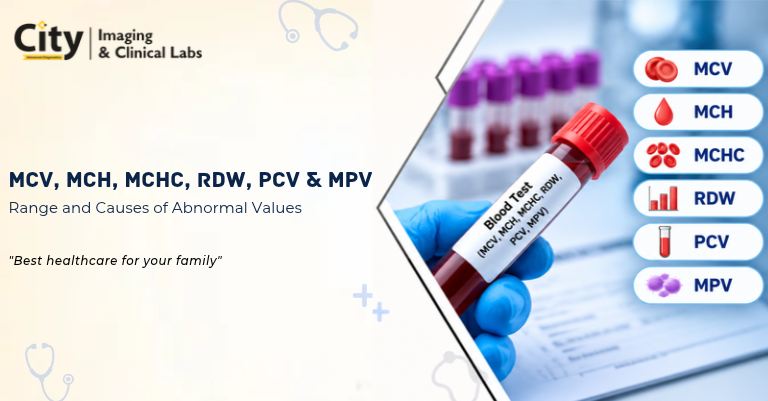

- Why these terms appear on your blood report
- Quick reference table
- MCV: mean corpuscular volume
- MCH: mean corpuscular haemoglobin
- MCHC: mean corpuscular haemoglobin concentration
- RDW: red cell distribution width
- PCV (haematocrit): packed cell volume
- MPV: mean platelet volume
- How doctors use these values together
- Why one abnormal value may not mean disease
- What can you do if these values are abnormal?
- When to seek urgent care
- Testing at City X-Ray & Scan Clinic
- Blood Test in Delhi: Blood Test Near Me with Free Home Sample Collection
- Key takeaways
- Frequently Asked Questions
- Book your blood test
Quick answer: MCV, MCH, MCHC, RDW and PCV describe the size, haemoglobin content and variation of your red blood cells, and MPV describes the average size of platelets. They help doctors find the type and likely cause of anaemia and other blood conditions. A value slightly outside the range is not always a problem. Interpretation needs your haemoglobin, symptoms and often more tests.
Why these terms appear on your blood report
If you have had a CBC (complete blood count), you may have seen letters like MCV, MCH, MCHC, RDW, PCV and MPV next to numbers. Many people do not know what they mean, and a value marked "high" or "low" can cause worry.
These values are called red cell indices (and platelet indices in the case of MPV). They describe the cells in your blood in more detail than the basic counts. Doctors use them like clues: they help to tell whether anaemia is likely due to iron deficiency, vitamin deficiency, a hereditary condition or a long-term illness, and whether further testing is needed.
This guide explains each one in simple language. Reference ranges below are general and approximate. Use the range printed on your own report.
Quick reference table
| Term | Full form | What it tells you | Approximate adult range* |
|---|---|---|---|
| MCV | Mean corpuscular (cell) volume | Average size of red cells | About 80 to 100 fL |
| MCH | Mean corpuscular haemoglobin | Average haemoglobin in each red cell | About 27 to 33 pg |
| MCHC | Mean corpuscular haemoglobin concentration | How concentrated haemoglobin is in red cells | About 32 to 36 g/dL |
| RDW | Red cell distribution width | How much red cell sizes vary | About 11.5 to 14.5% (RDW-CV) |
| PCV | Packed cell volume (haematocrit) | Percentage of blood made of red cells | Men about 40 to 52%; women about 36 to 46% |
| MPV | Mean platelet volume | Average size of platelets | About 7.5 to 11.5 fL |
*Ranges differ between laboratories and analysers. They also differ with age, sex and pregnancy.
MCV: mean corpuscular volume
What it is: MCV is the average size of your red blood cells, measured in femtolitres (fL).
Low MCV (microcytosis) means the red cells are smaller than normal. Common causes:
- iron deficiency
- thalassaemia trait or other inherited haemoglobin conditions
- long-term illness or inflammation (sometimes)
- lead poisoning (uncommon)
High MCV (macrocytosis) means larger than normal cells. Common causes:
- vitamin B12 deficiency
- folate (vitamin B9) deficiency
- alcohol use
- an underactive thyroid (hypothyroidism)
- liver disease
- certain medicines
- some bone marrow conditions
Normal MCV does not rule out anaemia. In some conditions, such as chronic disease or blood loss, the cell size can be normal while haemoglobin is low.
MCH: mean corpuscular haemoglobin
What it is: MCH is the average amount of haemoglobin in each red cell, in picograms (pg).
Low MCH usually goes with small, pale cells, as in iron deficiency and thalassaemia trait.
High MCH usually goes with large cells, as in vitamin B12 or folate deficiency.
MCH usually moves in the same direction as MCV, so the two are read together.
MCHC: mean corpuscular haemoglobin concentration
What it is: MCHC measures how concentrated haemoglobin is inside red cells (g/dL). It reflects how "colourful" or pale the cells look under the microscope.
Low MCHC (hypochromia) means pale red cells. It is typical of iron deficiency and some thalassaemias.
High MCHC is less common. It can occur in hereditary spherocytosis, in some autoimmune haemolytic conditions, or because of lab artefacts such as cold agglutinins, lipaemia (fat in the blood) or clumped cells. A repeat test or smear check is often needed.
Many people search for "blood test MCHC high" after seeing a mildly raised value. A mild rise is often not important by itself, but your doctor should see the whole report.
RDW: red cell distribution width
What it is: RDW shows how much red cells vary in size, a feature called anisocytosis. A normal RDW means the cells are mostly similar in size.
High RDW means a mix of small and large cells. It appears early in iron deficiency, in vitamin B12 or folate deficiency, after blood transfusion, and in some other conditions. When both iron and B12 are low, MCV can look normal while RDW is high.
Low RDW is not clinically significant.
RDW is often written as RDW-CV (a percentage) or RDW-SD (in fL). The ranges differ for each. Check which is on your report.
PCV (haematocrit): packed cell volume
What it is: PCV, also called haematocrit (Hct), is the percentage of your blood volume that is made of red blood cells.
Low PCV goes with anaemia, blood loss, pregnancy (due to extra fluid in blood), and overhydration.
High PCV can occur with dehydration, smoking, living at a high altitude, chronic lung or heart disease, sleep apnoea, some medicines, and in a bone marrow condition called polycythaemia vera.
PCV changes along with haemoglobin and RBC count. A small mismatch between them may be due to laboratory methods.
MPV: mean platelet volume
What it is: MPV is the average size of platelets, in femtolitres. Younger platelets are larger. The MPV helps doctors understand whether low platelets are due to poor production or to increased destruction.
High MPV may be seen when the body is making many new platelets (as in immune thrombocytopenia), and in some cardiovascular and metabolic conditions.
Low MPV may be seen in some bone marrow problems, certain infections and with chemotherapy.
MPV is a supporting value. It is not used alone to diagnose a disease and should be seen with the platelet count.
How doctors use these values together
| Hb | MCV | RDW | Possible meaning |
|---|---|---|---|
| Low | Low | High | Iron deficiency |
| Low | Low | Normal | Thalassaemia trait is possible |
| Low | High | High or normal | Vitamin B12 or folate deficiency |
| Low | Normal | Normal | Chronic disease, recent blood loss, early deficiency or kidney disease |
| Normal | Low or high | Any | Needs correlation. May reflect early or mild change |
The pattern guides the next test, such as serum ferritin and iron studies, vitamin B12, folate, a peripheral smear, or haemoglobin electrophoresis (HPLC). Treatment depends on the cause. For example, iron deficiency is treated with iron and by finding why iron was lost, and B12 deficiency by B12 supplements or injections.
Why one abnormal value may not mean disease
- Values often fall slightly outside the range in healthy people.
- Analyser and lab differences affect the numbers.
- Dehydration, recent illness or sample handling can change results.
- Age, sex, pregnancy and ethnicity change the normal range.
- Some people have mildly small red cells due to traits that cause no symptoms.
A repeat test, a blood smear examination or the doctor's clinical judgement usually clears the doubt.
What can you do if these values are abnormal?
- Do not self-diagnose or start supplements on your own. Iron in particular can be harmful if you do not need it.
- Meet your doctor with your report and symptoms.
- Ask about follow-up tests, such as ferritin, B12, folate, thyroid tests or HPLC.
- Eat a balanced diet with iron-rich foods (green leafy vegetables, legumes, jaggery in moderation, meat, eggs), vitamin B12 sources (dairy, eggs, fish, meat), and folate sources (greens, legumes, fruit).
- Follow treatment and repeat blood tests as advised.
When to seek urgent care
See a doctor promptly or seek emergency help if you have severe weakness, breathlessness, chest pain, fainting, a fast heartbeat, black stools or vomiting blood, yellowing of the eyes, or bleeding that does not stop.
Testing at City X-Ray & Scan Clinic
City X-Ray & Scan Clinic offers CBC and related pathology tests, including iron studies, vitamin B12, folate and haemoglobin analysis, through its laboratory services in Delhi.
Blood Test in Delhi: Blood Test Near Me with Free Home Sample Collection
If you are searching for a blood test near me or a blood test in Delhi, City X-Ray & Scan Clinic offers a wide menu of pathology tests with accurate and timely reports. City X-Ray & Scan Clinic is a NABH accredited (radiology) and NABL accredited (pathology) diagnostic centre, as per scope, with more than 32 years of experience in diagnostic healthcare in Delhi. You can find us at City X-Ray centres in Tilak Nagar, Vikaspuri and Vishnu Garden, and at City Imaging partner labs across West and South Delhi, including Dwarka (Sector 6 and Sector 12A), Janakpuri, Paschim Vihar, Hari Nagar, Najafgarh, Naraina, Palam, Sagarpur and Safdarjung Development Area (SDA). See the full list on our Locate Us page.
You can book a blood test at home with free home sample collection, or visit a centre. Ask about the CBC test price in Delhi, LFT test price in Delhi and our health check-up packages. Useful links:
- Best pathology lab in Delhi
- Free home blood sample collection
- CBC (complete blood count) test
- Liver function test (LFT)
- Health check-up packages
To book, call 011-4725-2000, send "Hi" on WhatsApp to 9577727772, or book online at www.cityxrayclinic.com. Timings differ by centre (most open from 7:00 AM or 8:00 AM, and some stay open until 11:00 PM), and free home sample collection is available for blood tests. Please check the Locate Us page or call before you visit to confirm that the scan you need is available at your nearest centre.
Key takeaways
- MCV, MCH, MCHC and RDW describe red cell size, haemoglobin content and variation. PCV is the percentage of red cells in blood. MPV is the size of platelets.
- Together they help find the type and cause of anaemia.
- A single value slightly out of range is often not serious. Doctors read the whole report.
- Do not start supplements without advice. Ask your doctor about follow-up tests.
Frequently Asked Questions
What is MCV in a blood test?
MCV stands for mean corpuscular volume. It is the average size of your red blood cells and helps to tell types of anaemia apart.
What does a high MCHC mean?
A high MCHC may be due to hereditary spherocytosis, autoimmune haemolysis, or a laboratory artefact. A mild rise is often not serious but should be reviewed by a doctor, sometimes with a repeat test or a blood smear.
What does a low MCHC mean?
Low MCHC means pale red cells and is typical of iron deficiency and some thalassaemias.
What is a normal RDW?
About 11.5 to 14.5% for RDW-CV in most laboratories. A high RDW means red cell sizes vary more than usual.
What does a high PCV mean?
High PCV can be due to dehydration, smoking, high altitude, chronic lung disease or a bone marrow condition. Dehydration is a very common and harmless cause.
What is the difference between PCV and haemoglobin?
Haemoglobin is the oxygen-carrying protein and is measured in g/dL. PCV is the percentage of blood volume taken up by red cells. They usually move together.
What is MPV and why does it matter?
MPV is the average size of platelets. It helps doctors understand the cause of high or low platelet counts and is read together with the platelet count.
Can low MCV be caused by something other than iron deficiency?
Yes. Thalassaemia trait, some chronic diseases and other conditions can lower MCV. Further tests, such as ferritin and haemoglobin electrophoresis, help to identify the cause.
Do I need treatment if only one index is abnormal?
Not necessarily. Your doctor will look at your haemoglobin, symptoms and other values, and may repeat the test or advise additional tests before treating.
Can diet correct abnormal MCV or RDW?
If the cause is a dietary deficiency of iron, B12 or folate, correcting it with diet and supplements under medical advice can improve the values. Other causes need different treatment.
Book your blood test
To book a CBC or a health check-up with City X-Ray & Scan Clinic, call 011-4725-2000 or visit www.cityxrayclinic.com.






Comments List